6.1 Logical Statements and Operations
To begin our study of logic, we must first define our most basic unit, the statement; we'll consider whether specific statements are true or not, and we'll combine statements to form compound statements and ultimately arguments.
The following sentences are statements:
The Packers will win the Super Bowl this year.
Elephants are afraid of mice.
Statements
A statement is a claim that is either true or false, but not both.
Notice that it doesn't matter for the definition whether we know if a statement is true or false; it simply has to be one or the other.
What, then, is not a statement? The following are a few examples:
Why is the sky blue?
This sentence is false.
The third is an interesting one. At first, it looks like a statement, because it makes a claim; however, upon closer inspection, we see that it isn't either true or false. This is known as the liar's paradox: if it were true, it would be false, which would mean it is true, which would mean...
In this chapter, we will commonly represent statements with letters to shorten the amount we have to write. For instance, we might define
: Tomorrow is the shortest day of the year.
In the coming sections, we'll spend a lot of time combining statements in various ways, and it can be easy to get lost in the notation and think of logic as some sort of abstract study of notation. Resist this temptation. Instead, always remember that the letters and symbols we use and manipulate are tied to simple statements like these examples. With every new operation we investigate, our goal is to not just focus on memorizing a list of symbols, but rather to understand why this operation makes sense.
Boolean Logic with Sets
Every time you use Google to search the Internet, the search engine turns to Boolean logic to narrow down the search results to give you what you're looking for, using key terms like "and," "or," and "not."
1. And
2. Or
3. Not
For instance, if you searched for "Frederick," the search engine would pull up results that contain that word (like the city tourism website, the Wikipedia article on the city, maybe the article for Frederick Douglass, etc.). If you searched for "Frederick Community College," the search engine would look for pages that contain those three words; it would search for "Frederick" AND "Community" AND "College."
If instead you search for "Frederick Community College," the search engine will search for pages that contain "Frederick" AND "Community" but NOT "College," so the FCC website will not be listed.
We can think of objects as belonging to sets; in this case, performing a search means looking for objects that belong to a specific list of sets. For instance, if you went to library and searched "History" AND "Fiction," you would find all the books that belong both to the History set and to the Fiction set (i.e. historical fiction).
As it turns out, we can deal with logic using either statements or sets. When working with statements, Boolean logic combines multiple statements that are either true or false into a compound statement that is either true or false. When working with sets, Boolean logic combines sets, and a search is considered "true" when it returns an object in that combination of sets.
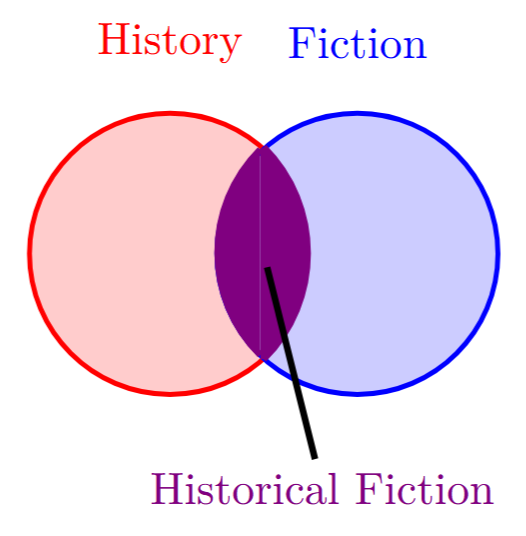
We can draw similar diagrams for the other two basic Boolean operations. For instance, if we searched for "History" OR "Fiction," the search would return any books that are either historical or fiction, or both.
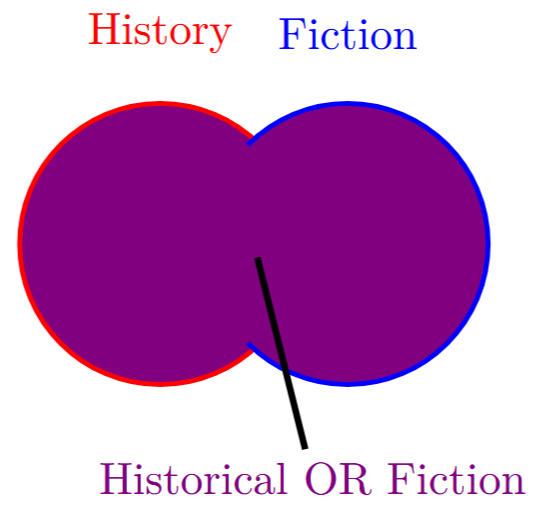
This is what is called the inclusive OR; it includes all values in the first set, plus all values in the second set, plus all values in the overlap. There is also an exclusive OR operation (that we won't consider) that includes all values in the first set and all values in the second set, but not the values in the overlap. It is equivalent to saying "Either history or fiction, but not both."
The inclusive OR is like the following question at a restaurant: "Would you like fries or a drink with that?" It is perfectly acceptable to respond "Both, please."
Finally, if we searched for NOT "Fiction," the search would return everything in the database except for those labeled "Fiction."
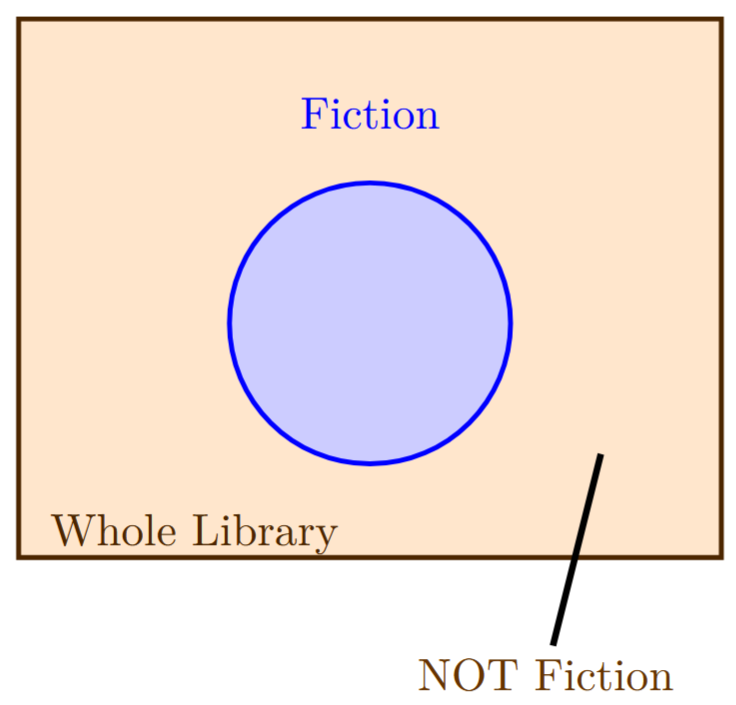
Diagrams like these will helpful to visualize combining statements using these three operations.
Example 1Search Logic View video (opens in new tab)
Suppose we are searching for universities in Mexico. Express a reasonable search using Boolean logic.
Solution
We could search for "Mexico AND university," but we would be likely to get results for universities in New Mexico (in the U.S.). To account for this, we could revise our search terms:
The quotes around New Mexico group those words together, so that the search engine will know that we want to exclude that string.
Also, in most search engines, including the word AND is unnecessary, since the search engines that if you provide two keywords, you want results that include both keywords. In Google, a negative sign in front of a terms is used to indicate NOT.
Thus, in Google, this search would be
Example 2Describing a Set View video (opens in new tab)
Describe the set of numbers that meet the following conditions:
Solution
We could describe this as "numbers that are even" AND "numbers that are greater than 12" AND "numbers that are less than 20," so we're looking for the overlap for these three sets.
The numbers that fit this description are
Boolean Logic with Statements
We can use these same three operators with statements; instead of thinking of objects belonging to sets, we'll think about whether statements are true or false.
For instance, consider the following two statements.
: Tokyo is in Iran.
Clearly, is true and is false. What about AND ? In words, this would be the compound statement "Greece belongs to the European Union, and Tokyo is in Iran."
Combining Statements with AND
The compound statement AND is only true if and are both true; if either one is false, that makes the compound statement false.
In this example, the fact that is false makes the compound statement break down; just because the first half is true isn't enough.
On the other hand, what if we wrote "Greece belongs to the European Union or Tokyo is in Iran"? In this case, the fact that the first half is true is enough to satisfy the compound statement.
Combining Statements with OR
The compound statement OR is true if at least one of and are true.
Therefore, OR is true, simply because is true.
Finally, what about NOT, the last of the three basic Boolean operators? What if we wrote "Greece does not belong to the European Union"? This statement would be false, because it is the opposite of a true statement. Conversely, "Tokyo is not in Iran" would be true, because it is the opposite of a false statement.
Negating Statements with NOT
If is true, then NOT is false; if is false, then NOT is true.
Notation
Although the notation can be a bit intimidating at first, it will soon become familiar. Just remember that the ideas are the same as the ones we've already seen; the notation is simply a shorthand that we can use to write compound statements more concisely.
Shorthand Notation for Basic Boolean Operators
AND:
OR:
NOT: or
To remember the difference between (AND) and (OR), you can think of the as looking like the "A" in AND. As we do examples, you'll quickly grow more comfortable with these symbols.
Example 3Translating to Symbolic Form View video (opens in new tab)
Let and represent the following simple statements:
: There is life on Europa.
- "There is life on both Mars and Europa."
- "There is life on neither Mars nor Europa."
- "There is life on Mars, but not on Europa."
- "There is either life on Mars or no life on Europa."
Solution
-
This is equivalent to saying "there is life on Mars" AND "there is life on Europa."
-
This is equivalent to saying "there is NOT life on Mars" AND "there is NOT life on Europa."
-
This is equivalent to saying "there is life on Mars" AND "there is NOT life on Europa."
-
This is equivalent to saying "there is life on Mars" OR ''there is NOT life on Europa.''
Try It
Let and represent the following simple statements:
: The manned lunar program is inactive.
"We never landed a man on the moon, and in any case the manned lunar program is inactive."
"Even though we never landed a man on the moon, the manned lunar program is still active."
"We landed a man on the moon and the manned lunar program is active."
"Even though we landed a man on the moon, the manned lunar program is inactive."
Example 4Translating from Symbolic Form View video (opens in new tab)
Let and represent the following simple statements:
: Bacon is delicious.
Solution
- "Banana bread is delicious or bacon is delicious."
- "Either banana bread is not delicious, or bacon is delicious."
- "It's not true that both banana bread and bacon are delicious."
- "Either banana bread is not delicious or bacon is not delicious."
Notice that the statements in (c) and (d) are logically equivalent; we'll prove this later (it's one of De Morgan's laws).
Try It
Let and represent the following simple statements:
:
is equivalent to
Truth Tables
Let's summarize what we know about these three operators. We'll begin with the AND operator, and after we've seen how to handle it, we'll use a similar approach with the OR and NOT operators.
AND: The combination of two statements using AND is true when both statements are true; otherwise it is false.
- If is true and is true, then is true:
| T | T | T |
- If is true and is false, then is false:
| T | F | F |
- If is false and is true, then is false:
| F | T | F |
- If is false and is false, then is false:
| F | F | F |
These are the only four possible combinations of truth values for and . We can summarize these four possibilities in a single table; this is called a truth table, as shown below.
Truth Table for AND
| T | T | T |
| T | F | F |
| F | T | F |
| F | F | F |
A computer scientist might write this table using 1 and 0 instead of T and F:
| 1 | 1 | 1 |
| 1 | 0 | 0 |
| 0 | 1 | 0 |
| 0 | 0 | 0 |
A truth table handles all the possibilities at once; it lists every combination of whether and are true or false, and for each of them, it lists whether the compound statement is true or false. Notice that once we have this table, if we know the truth values of and , we can look up the appropriate row in the table to find whether is true or false.
For instance, if is "All fish are purple" and is "North America is in the Western Hemisphere," we would look at the row where is false and is true--the third row--and note that the compound statement "All fish are purple and North America is in the Western Hemisphere" is therefore false.
Truth tables will be especially useful once we begin to look at more complicated compound statements. If the compound statement is some combination of two statements and , the first two columns will be the same as the first two columns shown here, and we'll slowly build up to the final compound statement by systematically adding columns. That's all we'll say for now; it'll make more sense later when we see actual examples.
Truth Tables
A truth table lists all the possible combinations of one or more simple statements (, , , etc.) and calculates the results of applying one or more operation(s) to these simple statements.
When building a truth table with one statement, there will only be two rows:
| T | |
| F |
If we work with two statements, there are four possible combinations of true and false:
| T | T | |
| T | F | |
| F | T | |
| F | F |
If we have three statements, we'll have to double the number of rows; we'll need to include the four rows above when is true, and include them again when is false.
| T | T | T | |
| T | F | T | |
| F | T | T | |
| F | F | T | |
| T | T | F | |
| T | F | F | |
| F | T | F | |
| F | F | F |
No matter how we order the rows, we need to account for these eight possibilities.
Now let's look at the truth tables for the other two operations.
OR: The combination of two statements using OR is true if at least one of the statements is true; it is only false if both of them are false. The truth table below summarizes this.
Truth Table for OR
| T | T | T |
| T | F | T |
| F | T | T |
| F | F | F |
NOT: The negation of a statement is true if the original statement is false; it is false if the original statement is true.
Truth Table for NOT
| T | F |
| F | T |
Sidenote: Logic Gates
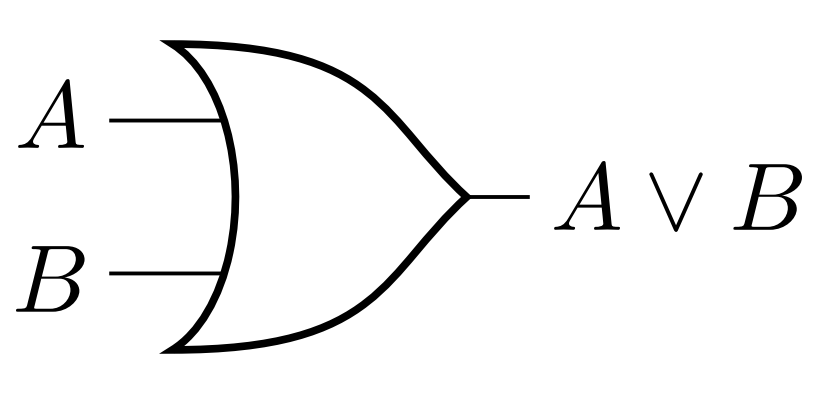
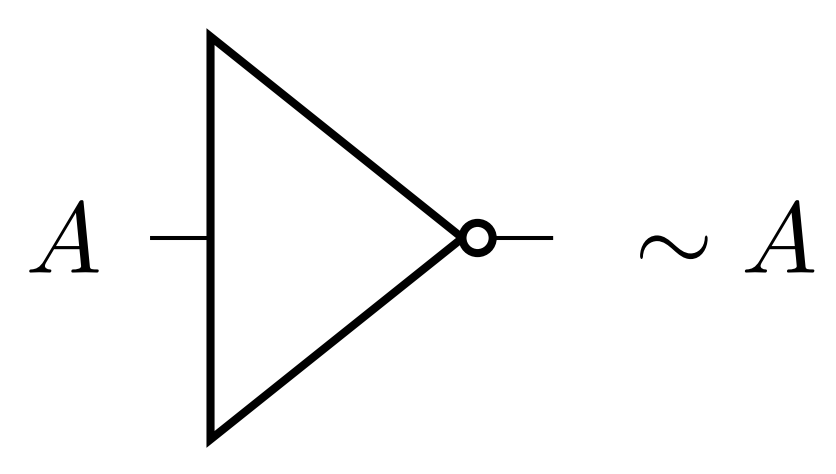
In circuit design, these three operations are drawn as "gates," or boxes that accept one or two inputs and give the appropriate output in each case. The diagram for each operation is shown below.
AND
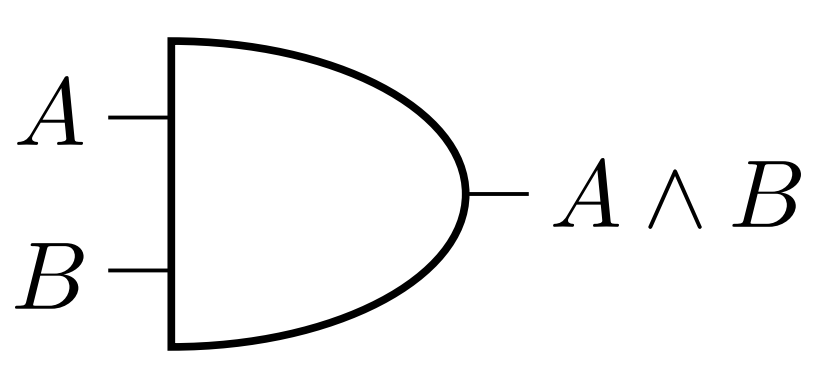
OR
NOT
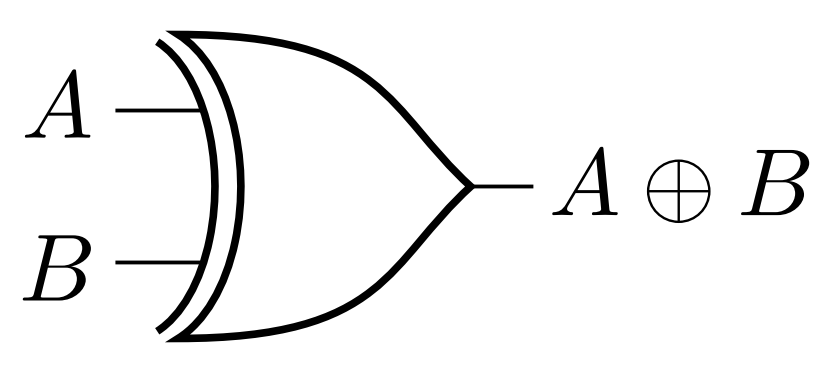
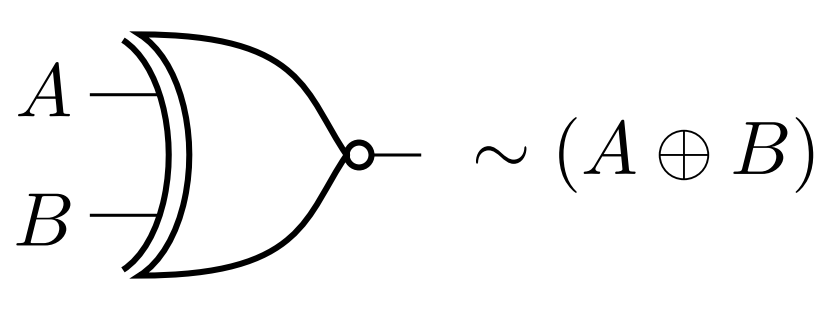
There is a fourth common gate, called the exclusive OR, which returns true if one input or the other is true, but not if both are true. This is often called XOR (symbolized by ), and represented with the following block.
XOR
For instance, the 7400 chip shown here contains four NAND gates; the remaining two pins supply power and connect the ground.
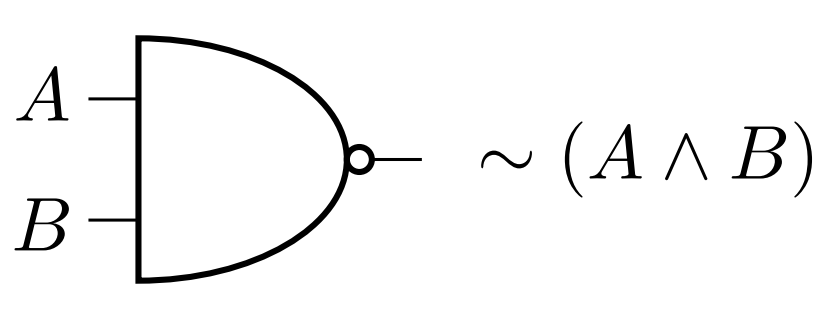
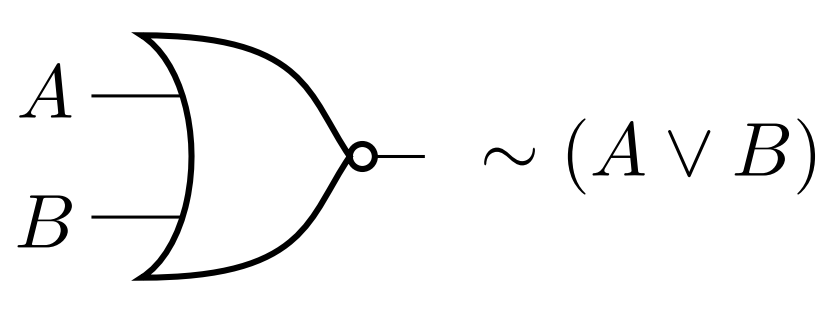
Each of these gates can be negated, which simply inverts all of the truth values. On the diagrams, this is represented with a small "bubble" at the end of the gate.
NAND
NOR
XNOR
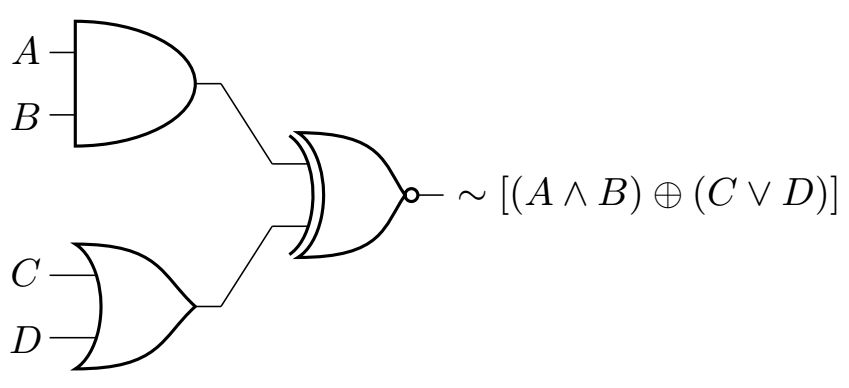
Circuits are created by cascading these gates, using the output of one gate as the input for another.
Combining Operations
As you may imagine, we can describe longer compound statements by using multiple operations. For instance, a university might advertise a scholarship by saying that "students are eligible if they have completed at least two years of college-level work and they have at least a 3.0 GPA or they have worked full-time for at least five years."
Let's take a look at this statement; first, define , , and to represent the simple pieces that are connected by the operations:
: a student has at least a 3.0 GPA
: a student has worked full-time for at least five years
Next, try to write the compound statement using the notation we've introduced so far:
There's a problem with this, though; there is some ambiguity in the way the statement is phrased. Does it mean that a student is eligible after completing two years of college with a 3.0 GPA or after working for five years (with no GPA requirement)? Or does it mean that the student is eligible after completing two years of college, as long as they EITHER have a 3.0 GPA OR have worked at least five years?
To handle this ambiguity, we can use parentheses to group statements together. This works like the order of operations in algebra; the parentheses tell us in what order to combine the simple statements.
In this example, if we wanted to make it clear that the first option is the correct one (a student is eligible after completing two years of college with a 3.0 GPA or after working for five years (with no GPA requirement)) we would group the first two statements together:
Evaluating Statements with Multiple Operations
Suppose we want to take the compound statement above and consider a specific case, whether a specific student meets the minimum requirements for the scholarship. All we have to know is whether , , and are true for this student. Then, if we substitute these values into the compound statement and get a true result, the student meets the requirements; if not, the student does not meet the requirements.
For instance, suppose a student applies who has completed two years of college and has five years of work experience, but only had a 2.5 GPA. For this student, is true, is false, and is true. If we substitute these values into the compound statement, we have
Now we can simplify this statement: the parentheses define the order in which we do so.
and F T T
For this student, the compound statement simplifies to T, so they meet the requirements.
Example 5Evaluating Statements View video (opens in new tab)
Evaluate the statement when is true and is true.
Solution
Substitute these truth values for and , and start by simplifying : Thus, when and are both true, is false.
Try It
Evaluate the statement when and are both false.
Truth Tables for Statements with Multiple Operations
We could repeat the substitution and simplification process shown above every time we encounter a new student applying for the scholarship, but it will be more efficient in the long run to simply account for all the possibilities for the students that could apply; this is precisely what a truth table does for us.
Let's practice with the same example, using the compound statement Since we have three simple statements (, , and ) we'll need eight rows to account for all possible combinations of truth values.
| T | T | T | |
| T | F | T | |
| F | T | T | |
| F | F | T | |
| T | T | F | |
| T | F | F | |
| F | T | F | |
| F | F | F |
Now, to build up to , we'll start by including a column for , using the rule for AND to create this column. Then we'll add another column that combines this new column with using the rule for OR. That final column will be the one we're interested in.
| T | T | T | T | T |
| T | F | T | F | T |
| F | T | T | F | T |
| F | F | T | F | T |
| T | T | F | T | T |
| T | F | F | F | F |
| F | T | F | F | F |
| F | F | F | F | F |
This table lists every possible combination of , , and , and the result for in that case. If we were sorting applications for this scholarship, we could look at every student and see which row of this truth table they fit into; if it is one of the first five, they are eligible, but if it is one of the last three, they are ineligible. In practice, we'd probably write a computer program to do the sorting for us, and we'd consider this logic in order to write that program.
Example 6Constructing a Truth Table View video (opens in new tab)
Construct the truth table for .
Solution
In this case, there are only two simple statements ( and ), so our truth table will only need four rows to account for all the possibilities.
| T | T | |
| T | F | |
| F | T | |
| F | F |
Next, we'll need columns for and , which will simply invert and :
| T | T | F | F | |
| T | F | F | T | |
| F | T | T | F | |
| F | F | T | T |
Finally, we'll combine the columns for and using the rule for :
| T | T | F | F | F |
| T | F | F | T | F |
| F | T | T | F | F |
| F | F | T | T | T |
Try It
Build a truth table for the statement .
| T | T | ||
| T | F | ||
| F | T | ||
| F | F |
| T | T | F | T |
| T | F | T | T |
| F | T | F | F |
| F | F | T | T |
Notice that we could have built the truth table in the last example without using the intermediate rows for and ; to do so, we could substitute each combination of and into the final statement to jump straight from the first two columns to the final column:
If is true and is true: Therefore, in the row where is T and is T, the compound statement is F. The other rows can be done similarly.
The reason we tend to build truth tables as shown in the example above—by slowly adding columns and only performing one operation per column—is that this systematic approach tends to be simpler and avoid errors.
Example 7Constructing a Truth Table View video (opens in new tab)
Construct the truth table for the statement .
Solution
Again, we are only dealing with two statements and , so we begin with the same two columns as before.
| T | T | |
| T | F | |
| F | T | |
| F | F |
Next we add a column for . Note that we're using the parentheses as a guide for the order; since the parentheses group the , we'll fill in that column first, then negate it.
| T | T | T | |
| T | F | T | |
| F | T | T | |
| F | F | F |
Finally, we negate this last column to get a column for .
| T | T | T | F |
| T | F | T | F |
| F | T | T | F |
| F | F | F | T |
Notice that the column for here is identical to the column for in the previous example. Again, this is no accident; this is another representation of one of De Morgan's laws (which we'll encounter later in this chapter).
Try It
Fill in the truth table below for the statement .
| T | T | ||||
| T | F | ||||
| F | T | ||||
| F | F |
| T | T | F | F | T | F |
| T | F | F | T | T | F |
| F | T | T | F | F | F |
| F | F | T | T | T | T |
Example 8Constructing a Truth Table View video (opens in new tab)
Construct the truth table for the statement .
Solution
Now we have three pieces (, , and ), so we'll need three starting columns and eight rows to account for all the possibilities.
| T | T | T | |
| T | F | T | |
| F | T | T | |
| F | F | T | |
| T | T | F | |
| T | F | F | |
| F | T | F | |
| F | F | F |
Next, we'll need and in the final statement, so we'll add a column for each of those.
| T | T | T | F | F | |
| T | F | T | F | T | |
| F | T | T | T | F | |
| F | F | T | T | T | |
| T | T | F | F | F | |
| T | F | F | F | T | |
| F | T | F | T | F | |
| F | F | F | T | T |
Next, add two more columns: one for and one for . The last step will be to combine these two columns with .
| T | T | T | F | F | F | F | |
| T | F | T | F | T | T | F | |
| F | T | T | T | F | F | T | |
| F | F | T | T | T | F | T | |
| T | T | F | F | F | F | F | |
| T | F | F | F | T | T | F | |
| F | T | F | T | F | F | F | |
| F | F | F | T | T | F | F |
Finally, combine these last two columns with the OR rule.
| T | T | T | F | F | F | F | F |
| T | F | T | F | T | T | F | T |
| F | T | T | T | F | F | T | T |
| F | F | T | T | T | F | T | T |
| T | T | F | F | F | F | F | F |
| T | F | F | F | T | T | F | T |
| F | T | F | T | F | F | F | F |
| F | F | F | T | T | F | F | F |
Quantified Statements
Some statements only make a claim about a specific category. For instance, one might say that "all politicians are dishonest." In this case, only those who fall into the category of politician are considered. This is an example of a quantified statement.
The words "all" or "some" (similarly "none" or "not all") are called quantifiers, since they refer to quantities, limiting the scope of a statement to a given category.
Quantifiers
The Universal Quantifier
The universal quantifier refers to all of a given category. The symbol
Example: To say that all human beings are mortal, we could write
" such that is a human being, is mortal"
Note: "none" is a variation of "for all." For instance, "no pig is beautiful" could be written " such that is a pig, is not beautiful" (although that phrasing, admittedly, sounds pretty odd).
The Existential Quantifier
The existential quantifier refers to some of a given category. The symbol
Example: To say that some dogs are retrievers, we could write
We can draw diagrams to represent quantified statements, like the following examples. We'll use circles to represent categories, but the size of the circles is not relevant; we're only interested in the location and interaction of the circles.
Example 9Diagram for the Universal Quantifier View video (opens in new tab)
Draw a diagram to represent the statement that "all battleships are ships."
Solution
The diagram below looks like a Venn diagram. The outer circle represents all ships, and the inner circle represents battleships.
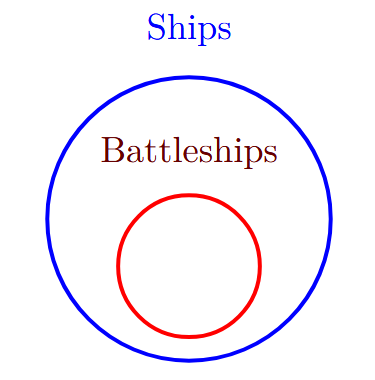
Notice that anything in the battleship category is also automatically in the ship category; hence, this represents the quantified statement that "all battleships are ships."
Example 10Diagram for the Existential Quantifier View video (opens in new tab)
Draw a diagram to represent the statement that "some clouds are white."
Solution
Now, the left circle represents all white things, and the right circle represents all clouds.
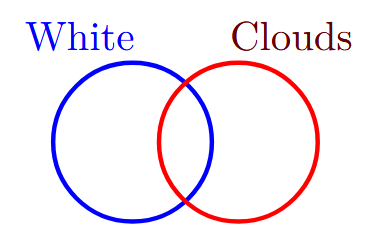
Notice that there is some overlap, which is the clouds that are white. However, there are things that are white that are not clouds (Paper! Snow! A ghost!) and some clouds that are not white. This diagram therefore accurately represents the statement that "some clouds are white."
Negating Quantified Statements
Negating a quantified statement is not initially an intuitive process. For instance, suppose we have a false statement like "all clouds are white." If we negate it, we should get a true statement.
You may be tempted to write the negation as "all clouds are not white." However, this too is a false statement, so it cannot be the negation of the first false statement.
The correct negation would be "NOT all clouds are white," which can also be written "some clouds are not white" or "there is at least one cloud that is not white."
Negating a Quantified Statement
The negation of the statement "all are " is "some are not ."
The negation of the statement "some are " is "all are not ."
Example 11Negating Quantified Statements View video (opens in new tab)
Write the negation of each of the following quantified statements:
- All vegetarians eat carrots
- Some birds are flightless
- Every car salesman is dishonest
- There are some foods that cause cancer
Solution
-
Some vegetarians do not eat carrots
-
All birds are not flightless OR No birds are flightless OR All birds can fly
-
At least one car salesman is not dishonest
-
No foods cause cancer
Notice that there can be several equivalent ways to phrase something in English that all correspond to the same logical statement.
Try It
Write the negation of the statement "All dogs go to heaven."
Some dogs don't go to heaven.
Exercises
In problems 1—10, determine whether or not each sentence is a statement.
-
1024 is the smallest 4-digit number that is a perfect square.
-
Doc Brown's time machine requires 1.21 jigowatts of power to operate.
-
All elephants are purple.
-
Don't do drugs.
-
-
Lizard people run the government.
-
What are you holding?
-
Don't believe everything you read.
-
More soldiers died from sickness than combat in the Revolutionary War.
-
This statement is a lie.
In problems 11—13, let and represent the following statements:
: We can go to the mall on Saturday.
Write each of the following statements in symbolic form.
- "It won't rain this weekend."
- "Either it will rain this weekend, or we can go to the mall on Saturday."
- "We can't go to the mall on Saturday, but at least it won't rain this weekend."
In problems 14—16, let and represent the following statements:
: It is not time to buy a house.
Write each of the following statements in symbolic form.
- "It is time to buy a house; interest rates are low."
- "Interest rates are not low, and it is not time to buy a house."
- "Either it is time to buy a house, or interest rates are not low."
In problems 17—22, let and represent the following statements:
: You graduate with honors.
Write each of the following statements in symbolic form.
-
"You study hard and you graduate with honors."
-
"You don't study hard, but you graduate with honors anyway."
-
"You study hard, but you still don't graduate with honors."
-
"You study hard or you don't graduate with honors."
-
"You don't study hard or you graduate with honors anyway."
-
"You don't study hard, or you don't graduate with honors."
In problems 23—26, let and represent the following statements:
: The Lakers will win the NBA championship.
Write each of the following statements in words.
In problems 27—30, let and represent the following statements:
: This is a mammal.
Write each of the following statements in words.
In problems 31—34, let and represent the following statements:
: Bacon is not healthy.
Write each of the following statements in words.
In problems 35—40, evaluate the truth value of the given statement for the given truth values of , , and .
-
, where is T and is F.
-
, where is F and is F.
-
, where is T, is F, and is F.
-
, where is F.
-
, where is F, is T, and is T.
-
, where is F, is F, and is T.
In problems 41—46, build a truth table for each statement.
In problems 47—50, write the negation of each quantified statement.
-
All mammals are land-based.
-
Some horses are not domesticated.
-
Some trains are late.
-
All basketball players are not tall.