Volumes by Slicing
General Volumes
We'll approach the problem of finding volumes the same way we did areas:
- Slice
- Approximate
- Integrate
Take a look at the picture below to see this process.
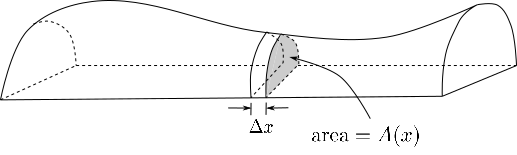
If we cut this entire volume into small slices (like a loaf of bread), we can make an approximation by assuming that the cross-sectional area is consistent across each slice. Then the volume of the slice is just like the volume of a cylinder is the area of the base times the height.
The approximate volume of the entire object will be the sum of the volumes of these slices:
Finally, by letting the slices become infinitesimally thin, we get the exact volume:
Thus, the main question in each problem is to find , the cross-sectional area as a function of .
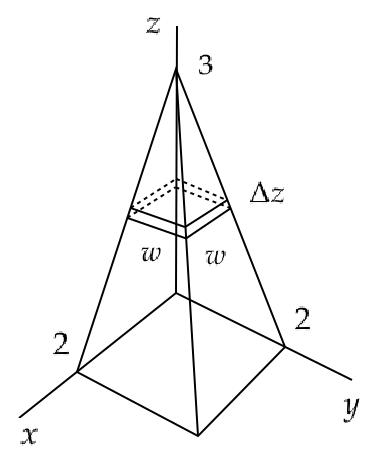
Find the volume of the solid shown below.
Solution
If we slice this object as shown, the cross sections will all be squares; the length of the sides will vary with . The integral will be in terms of , and the volume will be
All that remains, then, is to find an expression for in terms of ; there are several ways to do this, but I'll show an algebraic method for it.
Find
Look at the values of where we know what is:
- When ,
- When ,
As you can see in the picture, is a linear function of , so all we need to do is find the equation of the line that connects these two points:
- The slope of the line is
- The -intercept is , because .
Thus,
Putting it all together
Let be the region in the first quadrant bounded by the coordinate axes and . A solid has base , and cross sections through the solid perpendicular to the base and parallel to the -axis are squares. Find the volume of this solid.
Rotationally Symmetric Objects
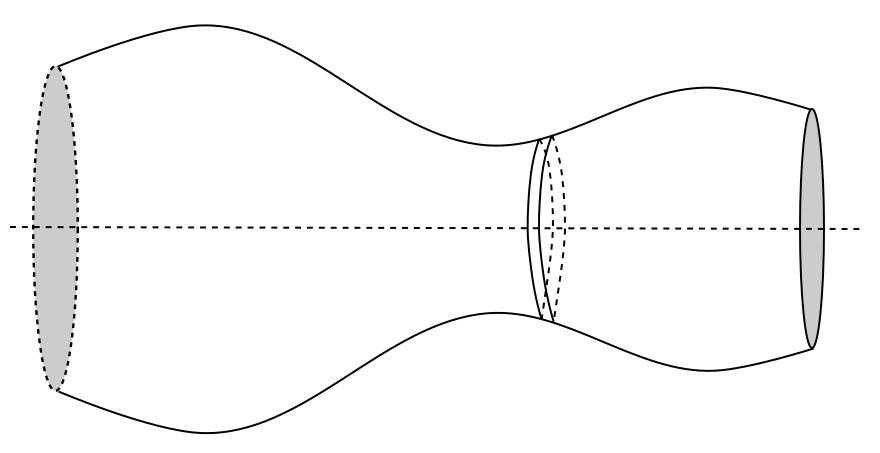
There's one whole class of problems where the object looks like the picture below.
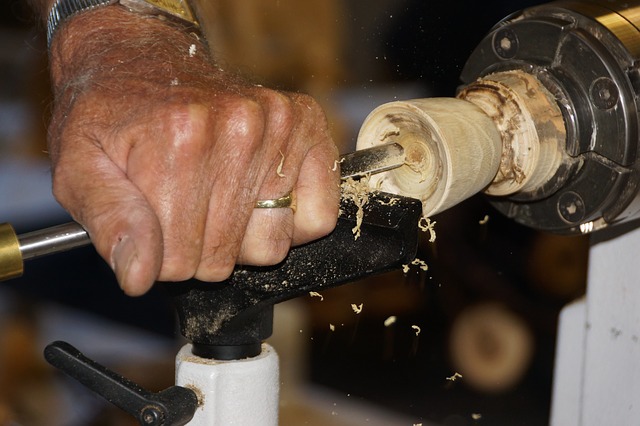
Think about a bowling pin or a baseball bat, or anything that could be made using a lathe, as in the picture below.
The nice thing is that the cross-sectional areas will all be circles; thus, all we have to find is the radius. If you look back at the first picture, you can see that the radius is the distance from the centerline to the outer edge, generally defined by a function in the examples we'll do.
Disks
If the object is solid all the way through, the slices will be solid disks, like the one shown below.
.jpeg "Generic Disk")
Then the cross-sectional area function will be so the volume will be and the problem will be to find as a function of .
Washers
There are some objects that are not solid all the way through, but have a hollow in the middle. The slices in this case will be washers, like this:
.jpeg "Generic Washer")
To find the cross-sectional area of a washer, subtract the missing area in the middle from the area of the outer area. If is the inner radius and is the outer radius, the area function will be so the volume will be
Disks
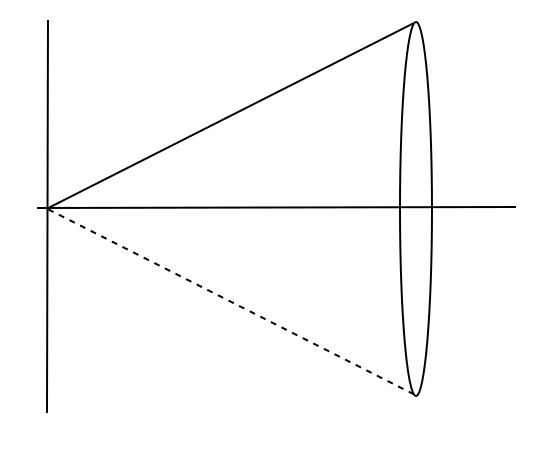
Revolve around the -axis between and , and find the volume of the resulting solid.
Solution
As we slice up this solid, the cross sections will be disks, and the radii will depend on the curve . At each value, the radius will be the corresponding value (which just happens to be in this case).
Revolve the region bounded by and around the -axis, and find the volume of the resulting solid.
Washers
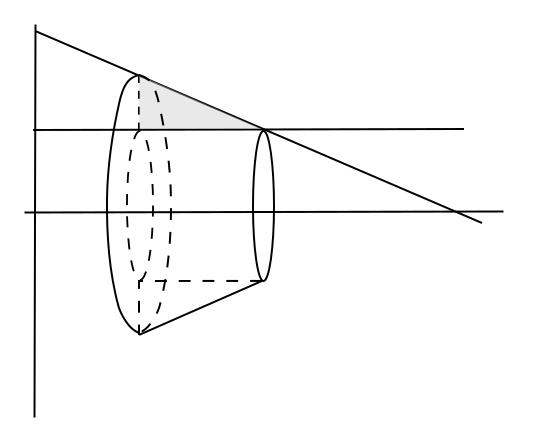
Revolve the region bounded by , , , and around the -axis, and find the volume of the resulting solid.
Solution
This solid is hollowed out in the middle, so the slices will be washers instead of disks.
The washers have two radii, the inner radius and outer radius. The inner radius will be defined by the curve that is closer to the center of rotation (), and the outer radius will be defined by the other curve.
Revolve the region bounded by and around the -axis, and find the volume of the resulting solid.
So far, all of these examples have involved revolving some region around either the - or -axis, but we can also revolve around some other vertical or horizontal line.
Revolving Around Arbritrary Line
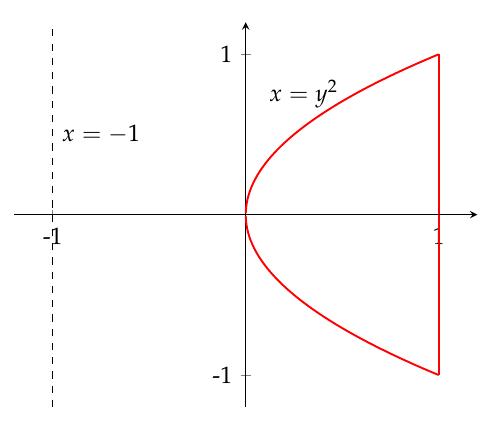
Revolve the region bounded by and around the line , and find the volume of the resulting solid.
Solution
As we slice this, we'll end up with horizontal washers, with thickness . The outer radius will be based on the line : it will be the distance between that and the center of rotation: :
Similarly, the inner radius will be the distance between and :
Thus the cross-sectional area function will be and the volume will be
Revolve the region bounded by and around the line , and find the volume of the resulting solid.