Evaluating Limits with Tables and Graphs
At the end of the last section, we got to this problem: What we meant by this is that we want to know what this fraction is doing for values of near In this section, we'll start to unpack that idea and see how to answer this question.
Our first idea is this: what if we just plug in for After all, if we want to know what's happening near where better to look than at
It was a good idea, but we get to this impossible answer of so we need to try something else. In fact, as we'll see later, getting the answer is actually pretty helpful, because it will give us an idea of what to do next (once we have a few more tools available to us).
Ways to Evaluate Limits
To get an answer to a question involving limits, we'll generally approach the problem in one of three ways:
- Graphing the function
- Building a table
- Using algebra to simplify the function
We'll often use more than one of these techniques on the same problem to compare their results.
Let's try all three of these methods on this example, and see what we can discover.
Graphing
This function, is probably not one that you can draw off the top of your head (unless your precalculus skills are particularly strong), so for now we'll have to rely on a graphing calculator. If we do so, we can get a graph that looks like this:
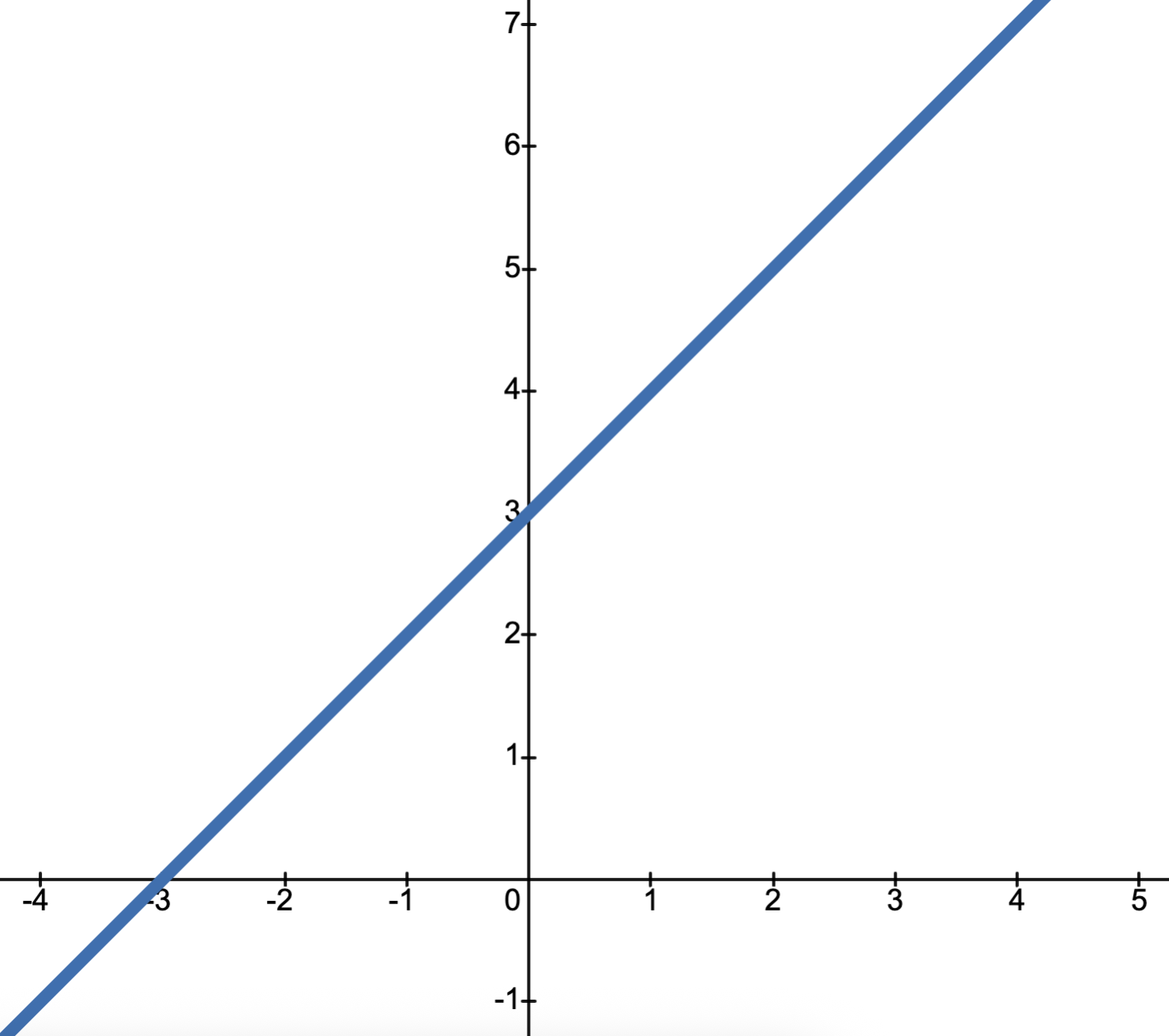
Does that strike you as odd? Does it seem strange that the graph of this rational function ended up just being a straight line?
In fact, if you look closer, you might get an idea of why the graph looks like this: this line has a slope of and a -intercept of meaning it has the equation
We set out to graph and we got the graph of
You can probably see why this is the case, but in case you can't, let's turn to another of our tools for evaluating limits: algebra.
Algebra
Let's try simplifying the function
We can factor the numerator, which will give us a common factor in both parts of the fraction that we can cancel.
Unsurprisingly, this matches the graph we saw above, so all is good, because everything is consistent.
look closer
Let's take another look at that example. Specifically, is it true that these two functions are equal? Everything you've learned in your algebra studies has said that yes, we can cancel things like this and still have something equal to what we started with.
But now we're ready for a more careful answer: it's not exactly true that these two functions are equal.
Why not? Well, what does it mean for two functions to be equal?
Two functions are equal if every input will give the same output for both functions.
Is this true for these two functions? Almost, but there's a glaring exception: when they give very different answers: one gives the output of and the other gives an error when you try to divide by 0.
This is the only issue, so we could accurately say
What does this mean for the graph? You may recall this from precalculus, but when a zero of the denominator can be canceled, that indicates a hole in the graph at that point. So the actual graph of this function looks like this:
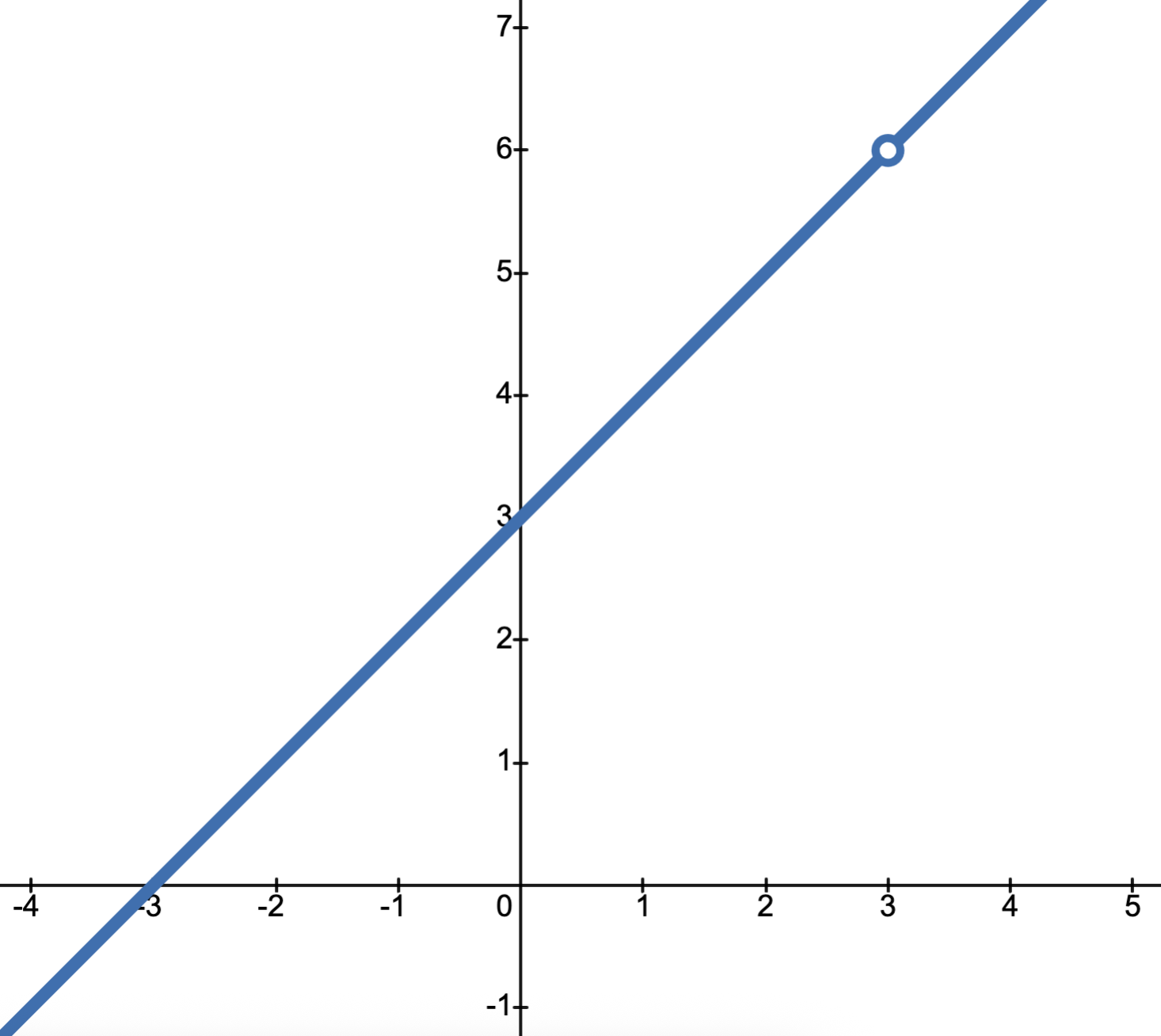
Note that the graphing calculator didn't recognize the hole in the graph, because it just calculated the value of the function at a bunch of values, plotted the results, and connected them.
Table
Let's tackle this same example by building a table, checking the answer for values of that get very close to 3 and looking for a pattern. At this point, with the graph we just drew, you can probably guess what answer we'll arrive at, but let's look at how to build a table before discussing the answer.
Our goal is to pick values that are very close to 3, and to do so in a pattern that we can keep extending. For instance, we won't use 3.4, 3.3, 3.2, etc., because we quickly run out of options. If instead we use values like 3.1, 3.01, 3.001, notice that we could continue this pattern indefinitely (in practice, three or four iterations is usually enough to get an answer).
Also, notice carefully that we want to use values on both sides of 3; we refer to this as taking the limit from both sides. What this means is that we'll be filling in a table like this one:
| 3.1 | |
| 3.01 | |
| 3.001 | |
| 2.9 | |
| 2.99 | |
| 2.999 |
In practice, filling out this table is simple, but tedious (which makes it ideal for computers to do for us). All we have to do is plug each value of into the expression for the function and get the result.
If you take a minute to do so, you should get a table that looks like this:
| 3.1 | 6.1 |
| 3.01 | 6.01 |
| 3.001 | 6.001 |
| 2.9 | 5.9 |
| 2.99 | 5.99 |
| 2.999 | 5.999 |
Here's the important bit: make sure that you can read through this table and see the trend. As the values of approach 3, the right-hand column shows that the values of get closer and closer to 6, and we imagine that this trend will continue.
Because of this, we can say Notice how the notation works: under the word we indicate what we want to approach, then we write the function that we're evaluating, and after the equals sign we write our conclusion for what the function values (-values) approach as approaches 3.
We could read this expression this way: the limit as approaches 3 of is 6. We could also write something like
Putting it all together
We'll focus more on the algebra in the next section, but for now, notice that we have three tools that we can use on this same example, and we can arrive at the answer using any of the three (although it's helpful to compare multiple methods, as we found).
In short, this function, has a relatively simple graph: it looks like a straight line with a hole at When we simplified it algebraically, we reduced it to the equation of that line, and we noticed that canceling the term indicated that there is a hole in the graph at Without the hole, the line would continue through the point Finally, the table showed us that as we input values of closer to , the outputs inched closer to making the results of all three methods consistent.
Comparing Methods
- Drawing a graph is often a great way to get an idea of what is happening as we approach different values with limits, but it's often difficult to draw a graph without a calculator. When it's convenient, though, we'll use a graph as much as we can.
- Building a table is simple, but pretty tedious, and it usually requires the use of a calculator. Because of this, we'll only use tables when we really have to; we'll use the other methods much more.
- Simplifying algebraically is the most common approach for evaluating limits, and we'll discuss this more in the next section.
One-Sided Limits
Remember when we were building the table to evaluate we plugged in values close to 3 on both sides? What if we had only checked on one side?
There are times that we choose to do this, especially if the two sides lead to different answers. Let's take a look at an example of this.
Example 1One-Sided Limits
Use limits to describe what's happening near for the function
Graph
Let's start with the graph. Notice that this function is undefined for and the factor can't be canceled, which means that there is a vertical asymptote in the graph at
Also, notice that the base function for this one is which has this graph:
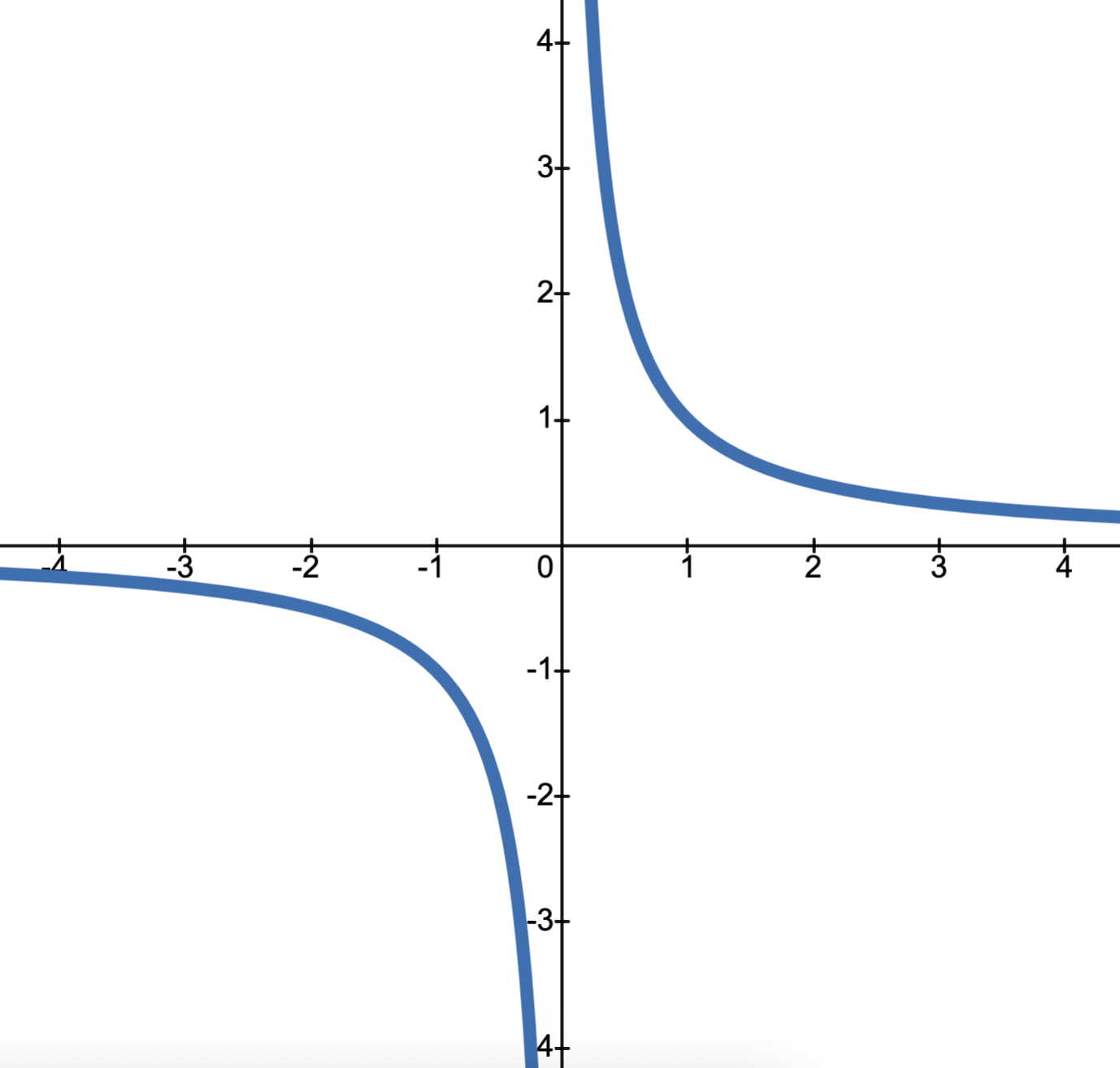
Changing to shifts the graph to the right by and multiplying by stretches it vertically, so our graph looks like this:
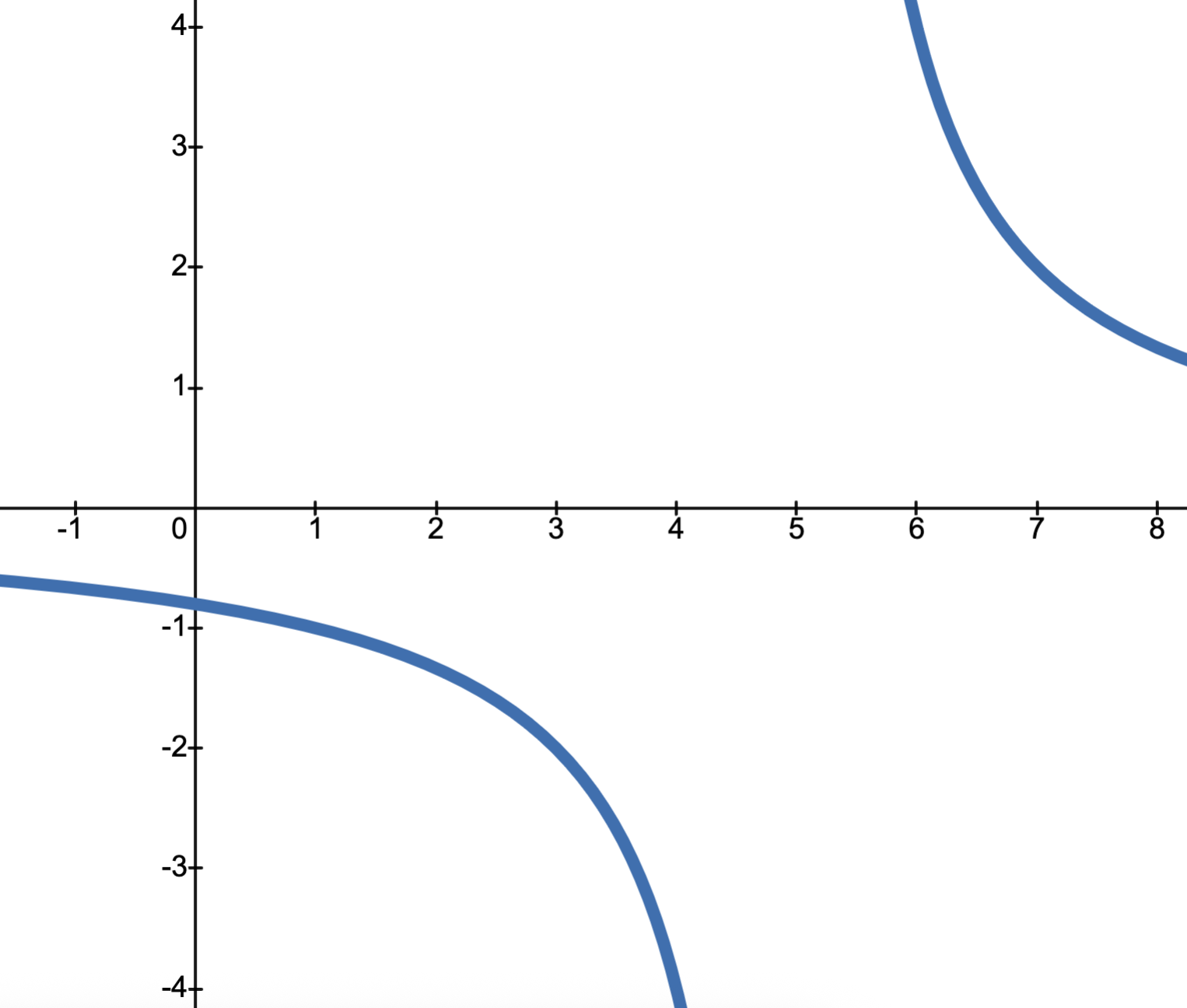
If we plug in values of close to for this function, we'll get different answers for inputs below and those above Notice that plugging in values lower than will give us negative answers that are going downward rapidly (heading toward ) and values higher than will give answers heading toward
Because of this, we'll identify the one-sided limits separately: Notice the small superscripts on the in the limit notation: the minus sign indicates that we're approaching from the left (values less than ), and the plus sign means we're approaching from the right.
Table
Let's see how we can observe the same thing from a table (if, for instance, we struggled to draw the graph by hand).
If we set up our table the same way we did before, we'd start with values like 5.1, 5.01, etc. from the right and values like 4.9, 4.99, etc. from the left.
The resulting table would look like this:
| 5.1 | 40 |
| 5.01 | 400 |
| 5.001 | 4000 |
| 4.9 | -40 |
| 4.99 | -400 |
| 4.999 | -4000 |
Make sure you can read the trend in the right-hand column. Notice that as we approach from the right, the results go from 40 to 400 to 4000, which indicates unlimited growth, trending toward so
Similarly, as we plug in values closer to from the left, the output grows in the negative direction, from -40 to -400 to -4000, trending toward so
What do we do when the right- and left-sided limits don't agree?
Limit Does Not Exist (DNE)
If the one-sided limits do not give the same answer, the two-sided limit (without the plus/minus in the limit notation) does not exist (often abbreviated DNE).
If , then DNE.
Because of this, we generally only talk about the one-sided limits when they differ. If they're equal, we'll just refer to the overall limit (which we can call the two-sided limit), and recognize in that case that the answer for the overall limit is the same as the answer for both one-sided limits.
Example 2Comparing Limit Methods
Consider the function Use all three methods described in this section to describe the function, and specifically use limits to investigate how the function behaves near
as well as what happens as approaches and
Algebra
Let's begin by simplifying the function, because if we pay attention as we do so, we can learn a lot about its graph.
By factoring the denominator, we found two zeros: at and . The one at was removed by canceling a matching factor from the numerator, which tells us that there is a hole in the graph at Because was not canceled away, we know that there is a vertical asymptote at
Furthermore, the simplified version is which is the result of shifting to the left by
Graph
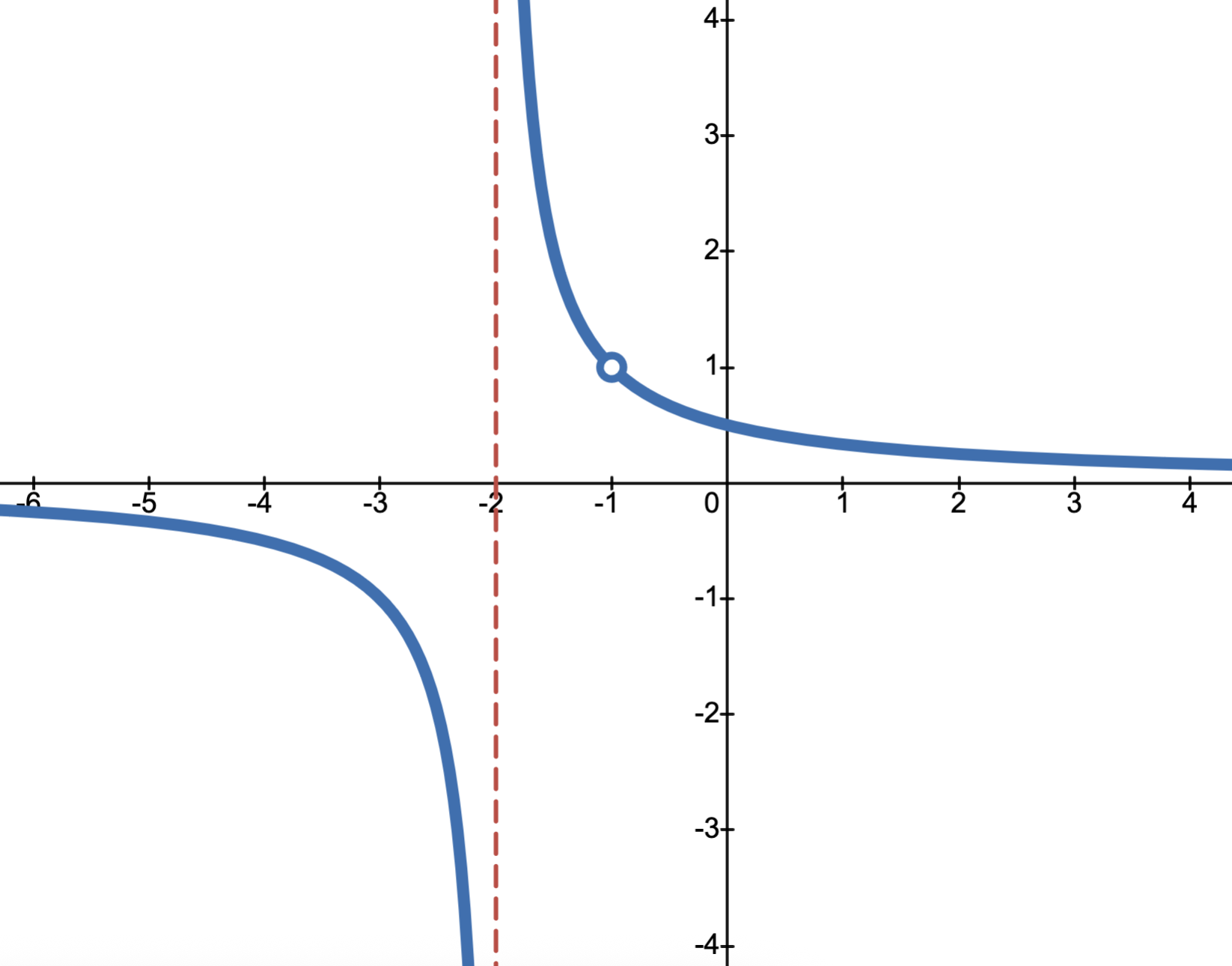
Based on these observations, we can draw the graph of with a fair amount of detail. The graph below was done with a calculator, but we could have drawn a rough sketch of this with what we gleaned above.
Table
We could build separate tables for each of the limits requested, but for the sake of space (and sanity), we'll just consider two here: one as approaches and another as approaches For the second table, we'll just need to pick values of that are increasing rapidly; for example: 10, 100, 1000, etc.
Here's the first table:
| -0.9 | 0.9091 |
| -0.99 | 0.9901 |
| -0.999 | 0.9990 |
| -1.1 | 1.1111 |
| -1.01 | 1.0101 |
| -1.001 | 1.0010 |
And the second:
| 10 | 0.0833 |
| 100 | 0.0098 |
| 1000 | 0.0010 |
Note that with approaching there's no sense of approaching from both sides, because there's nothing to the right of
We'll use these tables as we answer the questions posed about this function.
Evaluating Limits
Let's use what we found above to evaluate the limits we were given.
-
As approaches : based on the graph, we can observe a hole in the graph at so as approaches from either side, the values of will approach This is confirmed by the table we built; the values in the right-hand column got closer to as got closer to from each side. Note that we get the same result if we plug into the simplified form of because simplifying the function by canceling has the same result as filling in the hole in the graph.
-
To see what is happening around it's best to look at the graph. We see a vertical asymptote there, and we notice that on the right of the asymptote the graph is curving upward toward and on the left, it's going downward toward Therefore we conclude the following:
-
Take a look at the graph near there's nothing unusual happening here. The graph simply passes through that section without any breaks, holes, asymptotes, or anything else of interest. Because of that, we don't really need to do anything fancy with the limit (although we could build a table if we really wanted to waste some time). We can simply evaluate the function at and call it a day:
-
Finally, let's consider what happens as approaches positive or negative infinity. On the graph, this means looking at the end behavior, out to the right and left edges of the graph:
At both ends of the graph, the function values (-values) are approaching the horizontal asymptote of 0 (one from above and one from below). Thus,
Note that this is consistent with what we observed in the table for approaching
That was a long example, but it illustrates all of the tools we have at our disposal to think about the behavior of limits. Generally we'll only use one method at a time, though, so we won't have so much redundancy in one problem.
Let's wrap up this section with a few short examples to illustrate some special cases.
Example 3Limit of a Polynomial
Evaluate the following limit:
Solution
We can approach this one the same way as the previous ones, but let's try something a little different: let's try imagining the result we'd get by looking at a graph or table without actually drawing either of them.
What do we know about the graph of a polynomial? You may have forgotten this from precalculus, but every polynomial has a smooth, continuous graph; the most interesting thing about the graph tends to be its turning points and intercepts, but those aren't relevant here.
The fact that the graph is continuous, without any holes or asymptotes, means that it behaves like the limit as in the last example. Therefore, we can evaluate this limit simply by plugging in for
We'll revisit this idea in later sections, but for now, we'll simply draw the conclusion that for polynomials, we can evaluate limits by substitution; no fancy work is needed.
Example 4Limit of a Square Root Function
Evaluate the following limit:
Solution
You may be able to reason this one out, but more likely, you'll need to consider the graph.
In case you've forgotten, the graph of the square root function looks like half of a parabola on its side (because it's the inverse of ), and this one has been shifted to the right by 2 (because of the inside the root).
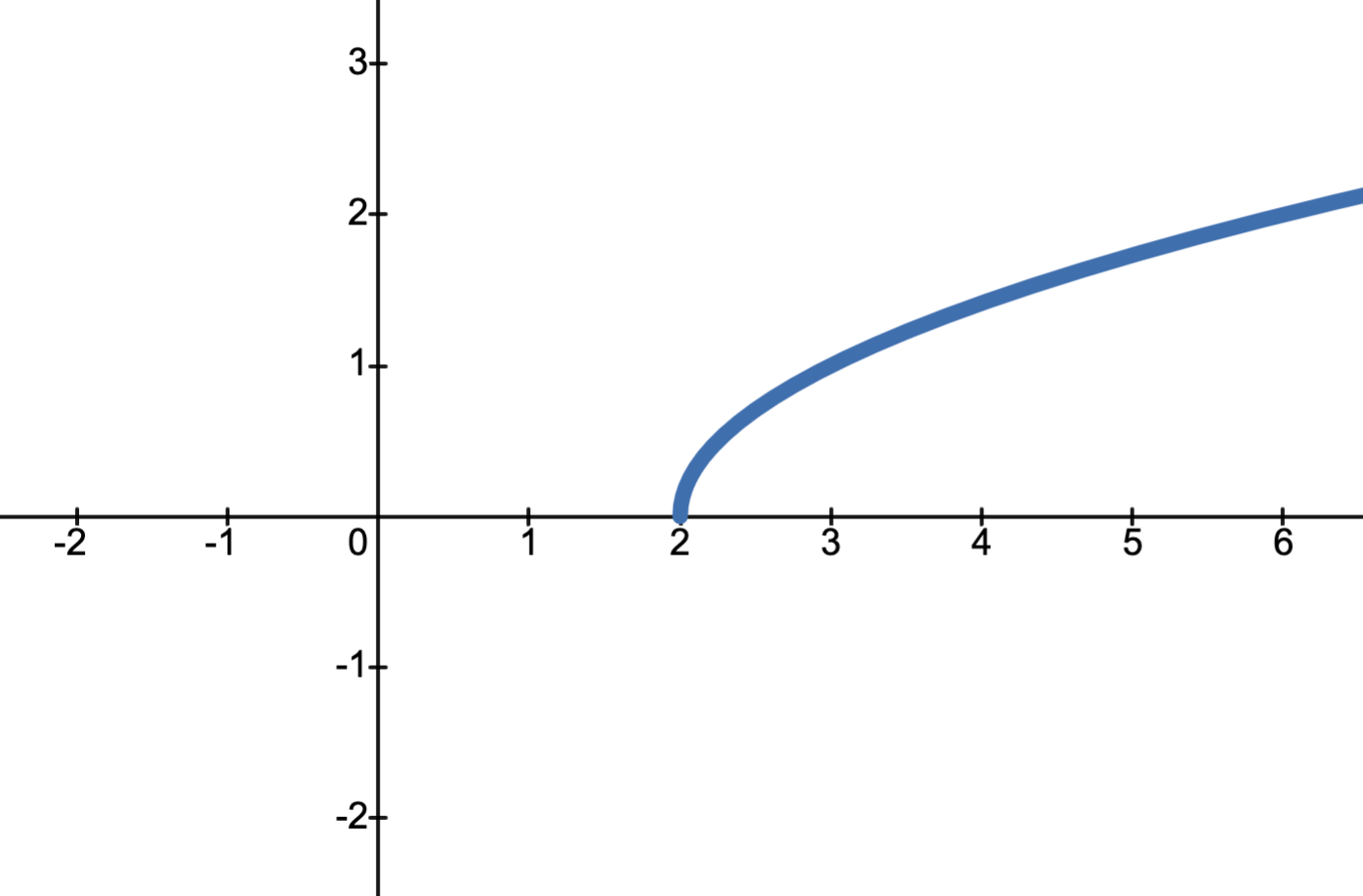
Now consider the limit as approaches This one may seem obvious; it looks like the function approaches right?
However, think carefully about how we evaluate limits: remember that we need the limits on both sides to agree in order to have an overall (two-sided) answer for the limit.
What's happening as approaches from the left? Since the function isn't defined there, the answer is that the left-sided limit doesn't exist. Therefore, the right- and left-sided limits don't agree, meaning the two-sided limit doesn't exist.
We could summarize the answer this way:
Example 5Limit of a Piecewise Function
Consider the following function: Find the limits as approaches and
Graph
Let's start with the graph. To graph a piecewise-defined function, like this one, imagine drawing each definition separately, but only including the section of it that's in the right domain.
For instance, the first like, describes a line with a slope of and a -intercept of We won't draw this whole line, but simply the portion of it to the left of
If it helps, we could figure out that the -value at would be so that section starts at the point and continues to the left, going up steps for every step to the left.
After doing this with all three sections, we get the following graph:
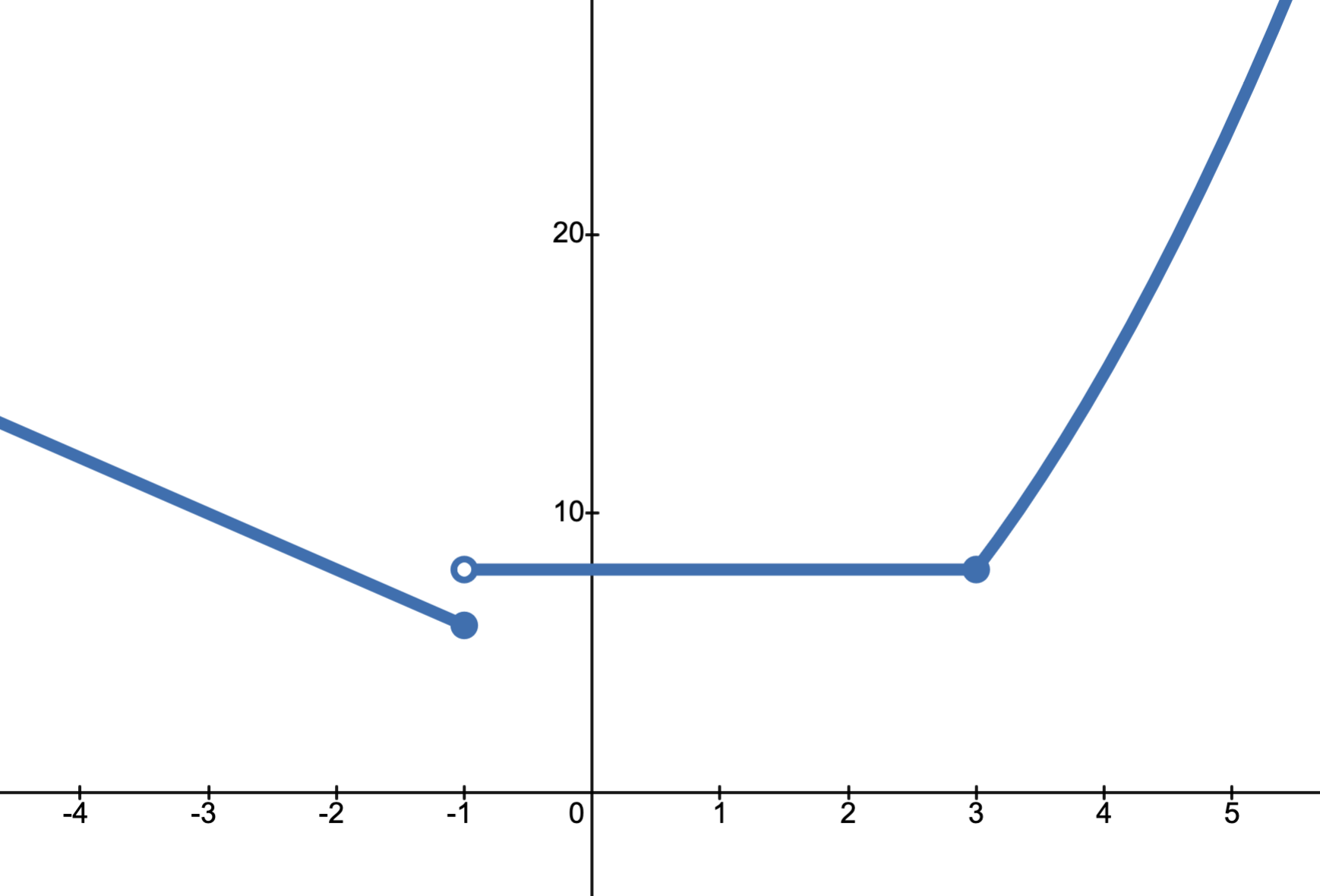
Notice at the two sides of the graph don't come to the same point, meaning that the left- and right-sided limits don't agree:
At on the other hand, the two branches of the graph meet at a single point, so the limit does exist there:
Table
We're not actually going to build a table here, but simply imagine what would happen if we did.
Let's start around From the left, we would pick values slightly smaller than and plug them into the first line: Unsurprisingly, the answers we would get from doing so would match what we could get by simply plugging into this expression: Thus we conclude that (if you don't believe me, try some specific values)
To get the limit from the right, we can imagine evaluating the function (using the second line, where ) for values of slightly larger than which would all give us as the result. We would then conclude that
Now try doing this for values to the left and right of and see if you can replicate the answers we found from the graph.
For a piecewise-defined function, then, we can draw a conclusion from this example. As long as the individual sections of the function don't have holes or asymptotes, taking the limit at one of the breakpoints in the function is as simple as substituting into the definition from the left and right and seeing if the answers agree.
Example 6An Odd Example
Consider the following limit: (note: in this course, unless otherwise specified, we'll assume that all trig functions use radians)
We could try building a table for this limit, but it won't be very helpful.
| 0.1 | -0.54 |
| 0.01 | -0.51 |
| 0.001 | 0.83 |
| -0.1 | 0.54 |
| -0.01 | 0.51 |
| -0.001 | -0.83 |
Do you see any pattern there? I sure don't.
Okay, let's take a look at the graph instead. Of course, the challenge here is knowing how to graph this function. It's probably not one that you've seen before, so we really need to rely on a graphing calculator. The graph looks like this:
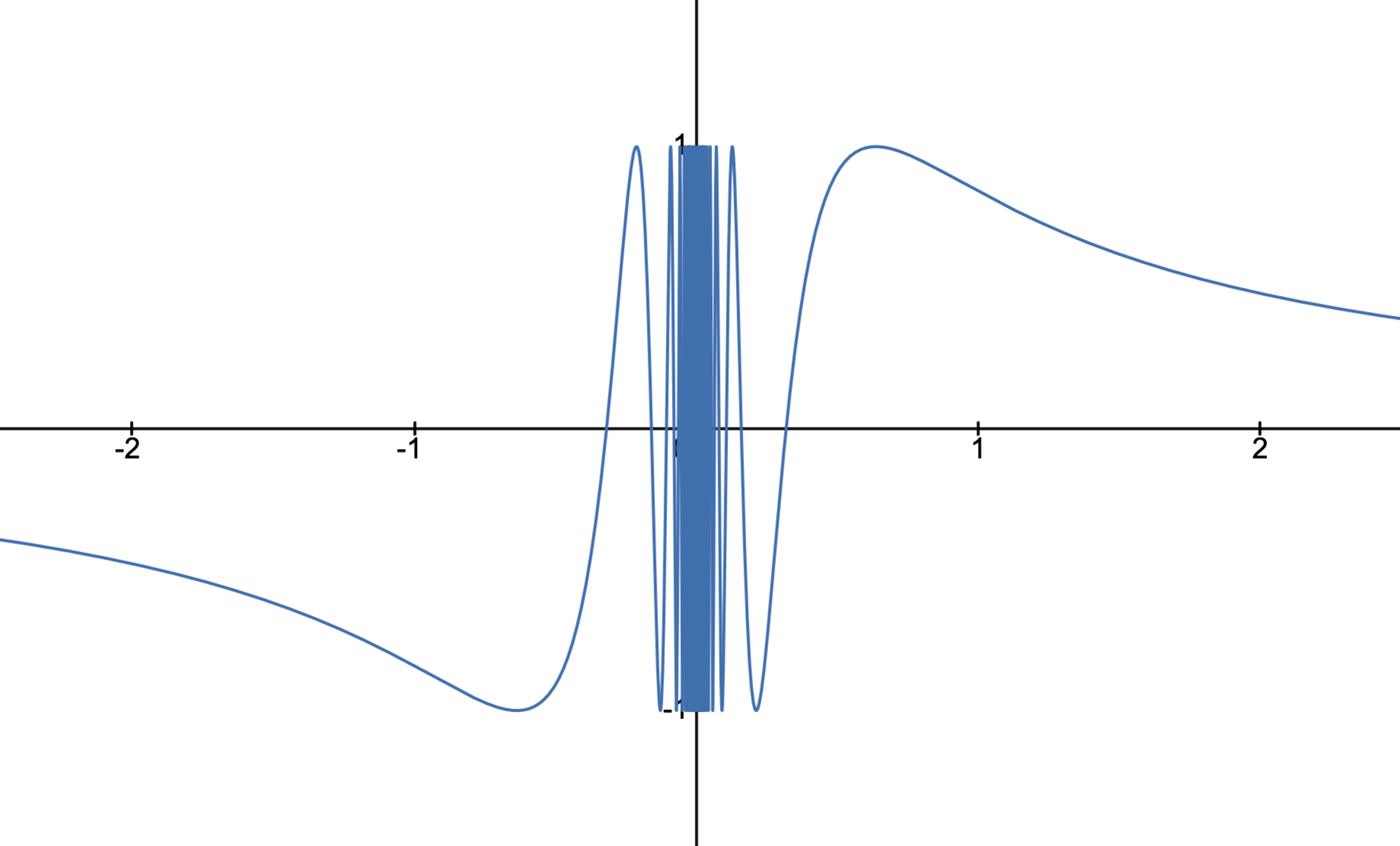
Notice how the function starts oscillating wildly near If you zoom in, you can see that this oscillation speeds up the closer you get to the middle:
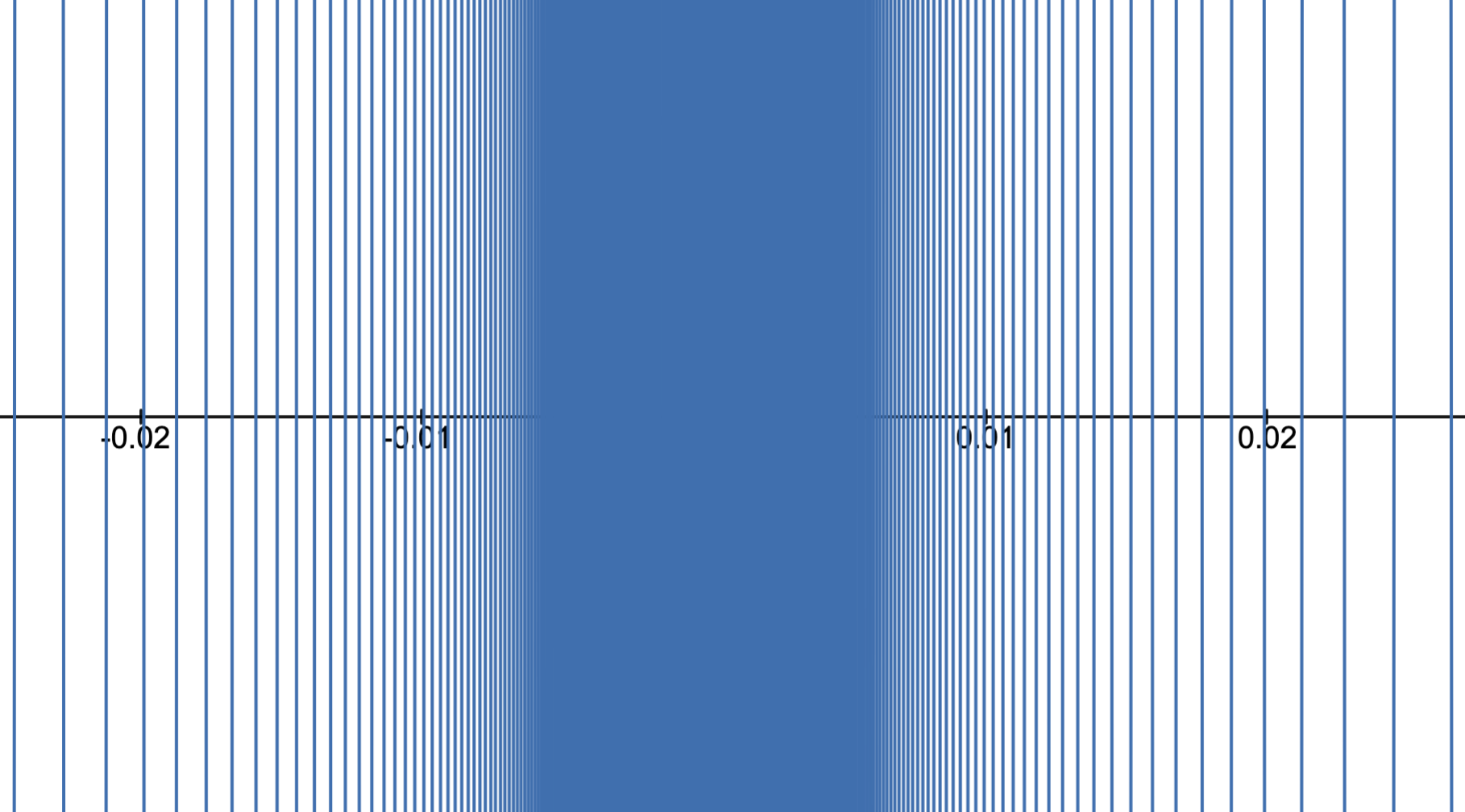
Because of this, building a table is hopeless, because we'd just find values randomly placed along one of these oscillating curves.
What is the answer for the limit, then? Well, notice that this function bounces back and forth between and moving faster and faster, but never settling down to a single value.
Since there's no single value that it approaches, we would say that this limit does not exist.
As we found in that last example, building tables and drawing graphs will always have their limitations. They are great tools to have available, but we can't rely on them every time.
Besides the fact that building these tables or graphs is tedious, they need the answer to be a nice round number. For instance, if the answer to a limit was is there any chance we'd be able to recognize that from the values in a table, or spot that point on a graph?
For all these reasons, we'll turn our attention in the next section to some algebraic techniques that we can reliably use to evaluate limits in general.
Homework: Evaluating Limits with Tables and Graphs
-
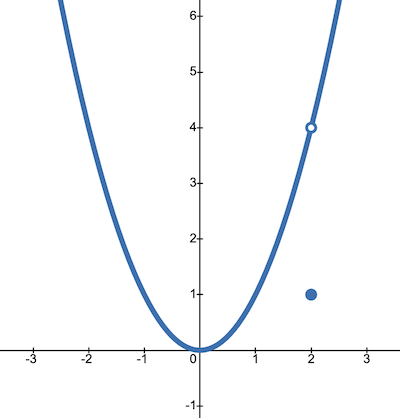
Use this graph of to calculate the limits below.
-
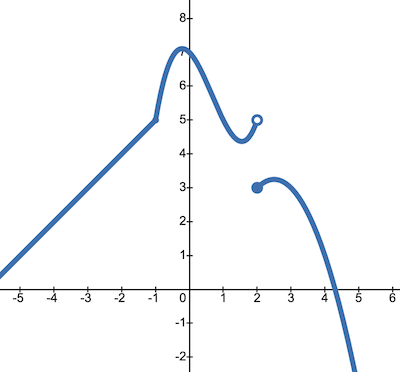
Use this graph of to calculate the limits below.
-
Build a table (using a calculator) to estimate the value of each of the following limits.
- if
-
For the following function, draw a graph and use that to evaluate and
-
For the following function, build a table and use that to evaluate and
-
Use a table or a graph to evaluate each of the following limits:
Homework Answers
- (a) 0 (b) 1 (c) 4 (d) 9 (e) 4
- (a) 5 (b) 5 (c) 5 (d) 5 (e) 3 (f) DNE (g) 3 (h) 3 (i) 3
- (a) 3 (b) 0 (c) (d) DNE (e)
- and DNE
- and DNE
- (a) (b) DNE (c) DNE